Lessons/Programmatic 101/Lesson 3
Vol. I, No. 3 · Programmatic 101
Auctions: first price, second price, and floors
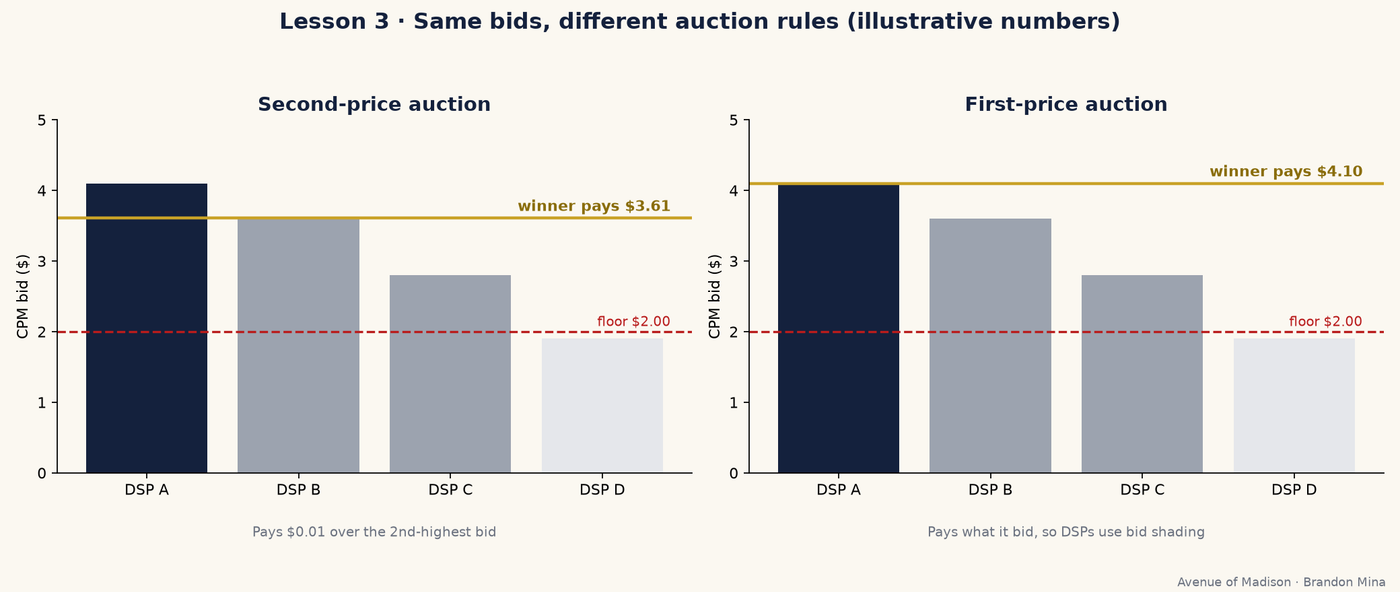
The same four bids produce very different prices depending on the rules.
By Brandon Mina·CEO, BrandPilot AI·Updated November 2026
Lesson 3 of 9
SyllabusAll 9 lessons
Programmatic 101 · course overview- 01The life of a programmatic impression
- 02Buy side vs. sell side: who sits where
- 03Auctions: first price, second price, and floors
- 04Waterfall vs. header bidding
- 05The four ways to buy programmatically
- 06How data and identity reach a bid
- 07Supply path optimization and supply chain quality
- 08Measuring programmatic: from impression to incremental outcome
- 09Where programmatic is going
Learning objectives
By the end of this lesson, you can:
- Explain how first-price and second-price auctions set the clearing price.
- Understand floor prices and why publishers use them.
- Explain bid shading and why it appeared after the industry moved to first-price.
The lesson
Under second-price, the winner pays just above the runner-up. Under first-price, now the norm on most open exchanges, the winner pays what it bid, so DSPs shade bids down to avoid overpaying. Floors protect publishers from selling too cheaply. Once you understand the rules, a "CPM" stops being a fixed number and becomes the outcome of a game.
Try the auction simulator →Under first-price, now the norm on most open exchanges, the winner pays what it bid, so DSPs shade bids down to avoid overpaying.
Lesson 03 · Auctions: first price, second price, and floors
What's the Big Idea? Key takeaways
- Auction rules, not just bids, decide the price paid.
- First-price is now the norm on most exchanges, which is why bid shading exists.
- Floors protect publishers from selling too cheaply.